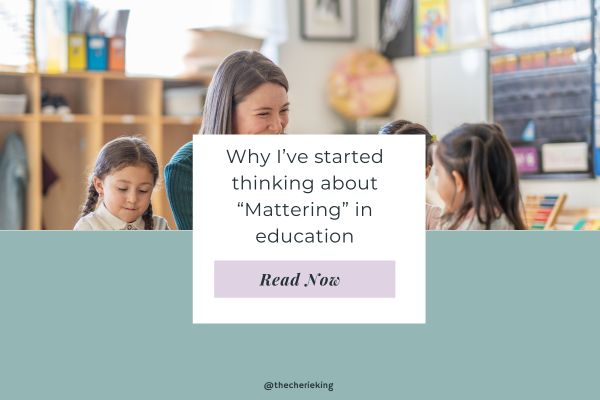
Why I’ve Started Thinking About “Mattering” in Education
After more than thirty years working in education, I have noticed that many of the challenges we talk about in schools tend to circle around the same themes.
Behaviour
Belonging
Student wellbeing
Teacher wellbeing
Engagement in learning
Over the years I have worked in classrooms, led schools, and supported teachers and leaders who are doing incredibly complex and demanding work. In each of these roles, I have often found myself returning to a similar question:
What helps young people feel safe enough, connected enough, and confident enough to learn?

While policies, programs and interventions certainly matter, my experience has consistently shown me that the environments we create and the relationships within them play a profound role in shaping how students experience school.
Recently I came across a concept in psychology that has stayed with me ever since: mattering.
The idea is simple, yet powerful.
Mattering refers to the experience of feeling that we are significant to others and that we add value to the community around us. It is the sense that we are noticed, that someone cares about us, that our presence is important, and that what we do contributes in some way to the people around us.
When people experience mattering, they are more likely to feel connected, motivated and resilient. When they don’t, the opposite can often occur; disconnection, disengagement and sometimes distress.
As I began reading more about the concept, I found myself reflecting on my own experience in schools.
For many years I have worked closely with teachers and school leaders supporting students whose behaviour is complex and challenging. In these situations we often focus on strategies, interventions and support plans, all of which are important. Yet when I think deeply about the students behind the behaviour, another question often emerges:
Do they feel that they matter here? Not in a superficial way, but in a genuine and sustained sense.
Do they feel noticed when they walk into the classroom?
Do they believe that adults in the school truly care about them?
Do they have opportunities to contribute in ways that are meaningful?
Do they feel that their presence makes a difference?
These questions are not always easy to answer, but they seem to sit quietly beneath many of the issues we grapple with in education. When students feel invisible, it is difficult for them to feel connected. When they feel that no one is paying attention, they may find other ways to be noticed. When they feel that they do not belong or cannot contribute, disengagement can quickly follow.
Of course, behaviour and wellbeing are influenced by many factors, and schools cannot solve everything that young people carry with them. But what schools can do - and what educators do every day - is create environments where students experience attention, care and opportunity to contribute.
In other words, environments where students feel that they matter.
When I think about the classrooms and schools where students seem to thrive, there are often small but powerful signals that communicate this;
Teachers who learn students’ names quickly and use them often.
Adults who notice effort, not just achievement.
Classrooms where students are trusted with responsibility.
Moments where a teacher pauses to check in with a student who seems quieter than usual.
Spaces where students’ ideas are taken seriously and where their voices are heard.
These actions might seem simple, but together they create a culture that quietly communicates a powerful message: you count here.
I also believe this idea extends beyond students, teachers themselves need to experience mattering.
Many educators today are working under enormous pressure. In conversations with teachers across many schools, I often hear a similar concern, that the work is relentless, the expectations are high, and at times they feel unseen in the effort they are putting in every day.
If schools are places where everyone is to feel that they matter, then that must include the adults as well.
When teachers feel valued and supported, they have greater capacity to build the relationships that students rely on. In this way, the experience of mattering can ripple throughout an entire school community.
At the moment, I am still very much in an exploration phase with this idea. I have begun reading research about mattering and reflecting on how it might connect with many of the things we already know about learning environments, belonging and wellbeing. I have also started sharing some early reflections on this concept and listening carefully to how other educators respond.
What I am increasingly curious about is how we might look at schools through a mattering lens.
What if, alongside conversations about curriculum, pedagogy and behaviour support, we also asked questions such as:
When do students feel that they truly matter in our classrooms?
What signals do our schools send, intentionally or unintentionally, about who matters and who does not?
How might student engagement change if every learner experienced a genuine sense of significance within their learning community?
These are not questions with quick answers. They require reflection, conversation and a willingness to look closely at the environments we create for young people.
For me, this exploration feels both exciting and deeply connected to the work I have been involved in for many years. In many ways, the idea of mattering seems to sit quietly at the intersection of behaviour, belonging, wellbeing and learning.
It may not be the only lens we need in education, but it may be an important one.
Over the coming months I hope to continue reading, reflecting and having conversations with educators about this concept. I am interested in learning how others understand and experience mattering in their classrooms and schools.
Because perhaps before students can fully believe they are capable learners, they first need to know something even more fundamental.
They need to know that they matter.
Connect with me:
Facebook: https://www.facebook.com/thecherieking
Instagram: https://www.instagram.com/thecherieking/
