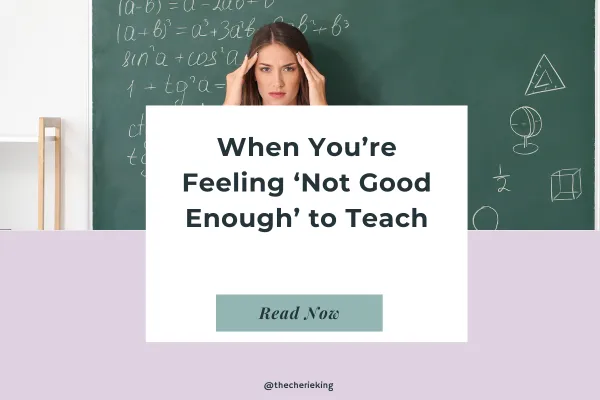
When You’re Feeling “Not Good Enough” to Teach: 5 Ways to Reclaim Your Confidence
If you’ve ever finished a day at school, sat in your car in the quiet, and wondered, “Am I even cut out for this?", please know, you are not alone.
In those first few years of teaching, self-doubt doesn’t just knock on the door; it often moves in. You’re juggling lesson plans, complex behaviours, mountains of paperwork, and the heavy weight of wanting to make a real difference. It’s so easy to look around the staffroom and feel like everyone else has it figured out while you’re just trying to keep your head above water.
But here is the truth I want you to carry with you today: Feeling “not good enough” doesn’t mean you’re failing. It means you care deeply. That caring heart is actually your superpower.

Here are five calm, practical ways to move from self-doubt to self-trust and start seeing the capable, heart-led teacher you already are.
1. Normalise the doubt (it’s a sign of growth)
Every seasoned teacher you admire once stood exactly where you are. Reflection is what makes you a great educator, it shows you are thinking, learning, and attuning to your students. When that inner critic whispers, "I can't do this," try a gentle reframe: "I’m learning how to do this."
2. Anchor yourself in connection, not comparison
In the age of Instagram-perfect classrooms, it’s easy to feel "less than." But remember: you are seeing someone else’s Chapter 20 while you are living your Chapter 2. Your students don't need a perfect Pinterest display; they need you. They need your presence, your smile, and the safety you provide. Focus on the connection in the room, not the perfection on the screen.
3. Celebrate the "micro-wins"
When we feel overwhelmed, we tend to focus on the one thing that went wrong rather than the ten things that went right. Start a "Small Wins" journal. Did a child smile at you during a transition? Did you take a deep breath instead of reacting to a loud moment? These aren't small, they are the building blocks of a successful career.
4. Lean on support, not isolation
Teaching was never meant to be a solo sport. The beginning years can feel lonely, but you don’t have to carry the weight by yourself. Find your "village", whether it’s a trusted mentor, a colleague who "gets it," or a community of peers. Asking for help isn't a sign of weakness; it’s a sign of wisdom.
5. Your wellbeing is the classroom's weather system
You cannot pour from an empty cup, and you certainly cannot co-regulate a child from a state of burnout. Investing in your own wellbeing is a professional responsibility. Try building "micro-moments" of rest into your day:
One slow sip of tea before the bell rings.
Three deep breaths between classes.
A 60-second reset in the fresh air during your break. When you are calm, your students feel safe enough to settle and learn.
A closing thought
That voice saying you aren't enough? That's just fear talking. You are already enough. You are learning. You are growing. And every child in your care is better for having you as their teacher.
Want to bring more calm into your classroom today? I’ve created something just for you. Download my FREE Calm Classroom Toolkit, it’s filled with mindfulness visuals, emotional regulation prompts, and practical strategies to help you and your students thrive together.
Connect with me:
Facebook: https://www.facebook.com/thecherieking
Instagram: https://www.instagram.com/thecherieking/
