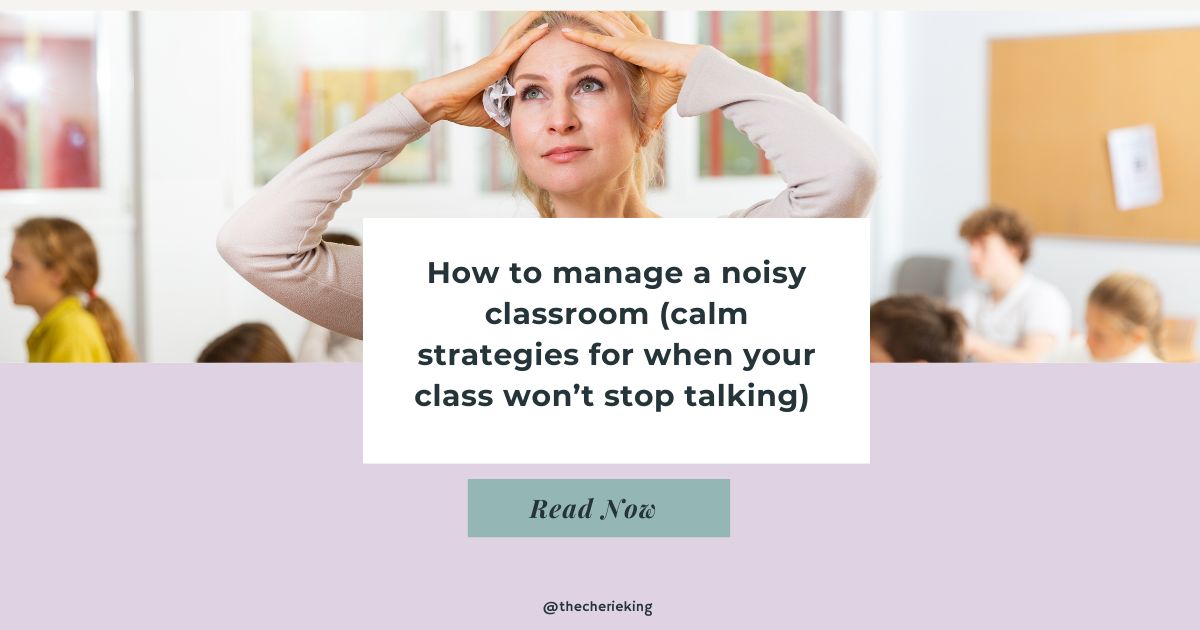
How to manage a noisy classroom (calm strategies for when your class won’t stop talking)
Every teacher has been there. You begin giving instructions…
The side conversations continue. You pause. They pause. You start again, and within seconds, the buzz returns.
A consistently noisy classroom can feel draining. It can chip away at your confidence and leave you wondering, “Why can’t I get control?” Before we reach for louder voices or tighter consequences, let’s pause and ask a different question: what might this behaviour be communicating?
Because excessive talking is rarely about disrespect, more often, it’s information.

Understanding What the Talking Might Be Telling Us
When a class feels excessively talkative, it’s rarely about defiance. More often, it’s information. It might be telling us:
The lesson doesn’t yet feel meaningful or accessible
The expectations haven’t been explicitly taught and practised
The routine feels unclear or unpredictable
The room is overstimulating and nervous systems are unsettled
Connection with peers feels more rewarding than the task at hand
Talking is often a sign of energy, curiosity, or dysregulation, not disrespect. When we shift from “How do I stop this?” to “What do they need right now?” we move from control to clarity.
Calm, Connection-First Strategies That Strengthen Focus
When a classroom feels noisy, our instinct can be to regain control. But what we’re really building is something deeper, predictability, safety, and shared responsibility.
Here are practical, grounded ways to strengthen focus without escalating the room.
Teach expectations as skills - not just rules
Children don’t automatically know what “listening” looks like.
Whole-class attention is a skill.
Transitions are a skill.
Working quietly is a skill.
From day one, and often beyond, we teach, model, practise, and rehearse these routines.
Show them:
What ready-to-learn looks like
What it sounds like
What it feels like
Then practise it together.
Predictability reduces anxiety and when children feel safe in the routine, noise naturally decreases.
Use consistent, calm non-verbal cues
Your voice doesn’t need to compete with the room. Choose one or two clear, consistent signals:
A raised hand
A soft chime
A call-and-response
A visual countdown
The power isn’t in the cue itself, it’s in the repetition. When students know exactly what the signal means, they respond with less resistance and more automaticity. We’re building rhythm, not reacting to chaos.
Spotlight what you want to see
Children move toward attention.
Instead of focusing on who is still talking, gently notice who is ready. “I can see three people with eyes on me.” “Thank you for showing calm bodies.” Specific, sincere acknowledgment builds culture.
We’re not bribing, we’re reinforcing belonging and clarity.
Add movement before expecting stillness
Young nervous systems are not designed for extended sitting. Sometimes chatter is simply energy needing somewhere safe to go.
Try:
A 30-second stretch
A shake-and-freeze reset
Slow breathing with arms rising and falling
Movement discharges stress hormones and resets attention.
Regulation before expectation.
Vary engagement to match energy
If attention is slipping, curiosity may need reawakening.
Blend:
Short direct instruction
Partner discussion
Hands-on materials
Visual prompts
Choice where appropriate
Engagement grows where children feel involved because when learning feels participatory, talking becomes purposeful.
If the pattern persists…
If noise continues despite these foundations, pause, not to tighten control, but to gather information.
Gentle individual check-ins
Sometimes the most talkative child is seeking connection. A quiet moment after class can sound like:
“I’ve noticed it’s been tricky to stay focused. Is something feeling hard?”
Curiosity builds insight, insight builds solutions.
Adjust the environment
Seating isn’t punishment, it’s design and small changes in proximity, spacing, or layout can reduce social triggers and increase focus.
Shape the environment so it supports regulation.
Collaborative problem-solving
When appropriate, involve the class:
“I’ve noticed we’re struggling with focus during this time. What do you think would help us?”
When students help build expectations, they feel ownership, a sense of belonging increases accountability.
And now, let’s talk about you
A consistently noisy classroom can be exhausting,It can chip away at your confidence and can make you question your capability.
But please remember:
Improvement takes time.
Systems take repetition.
Culture takes consistency.
Protect your calm where you can, it can be as simple as:
Taking one slow breath before responding.
Leaning on a colleague who understands.
Celebrating the small shifts, because they matter.
Your wellbeing is not separate from classroom wellbeing, because when you stay steady, the room steadies and you don’t have to do this perfectly to do it well.
You are learning, you are building and you are growing into the calm leader your classroom needs.
Conclusion
Managing a talkative class is something every educator experiences at some point. It doesn’t mean you’ve lost control, it means you’re working with developing nervous systems, growing social skills, and big energy in a shared space.
With consistency, clarity, and patience, you can shape a classroom where focus feels safer and more natural. Remember, the goal isn’t perfect silence; it’s creating an environment where communication is purposeful, expectations are understood, and learning can truly flourish.
Keep refining, keep rehearsing and keep leading with calm.
You are building something that takes time and that work matters more than you might realise.
Want to bring more calm into your classroom today? I’ve created something just for you. Download my FREE Calm Classroom Toolkit, it’s filled with mindfulness visuals, emotional regulation prompts, and practical strategies to help you and your students thrive together.
Connect with me:
Facebook: https://www.facebook.com/thecherieking
Instagram: https://www.instagram.com/thecherieking/
Cherie King is an experienced educator with years of experience in teacher mentorship and classroom regulation. This post is based on firsthand classroom experience.
