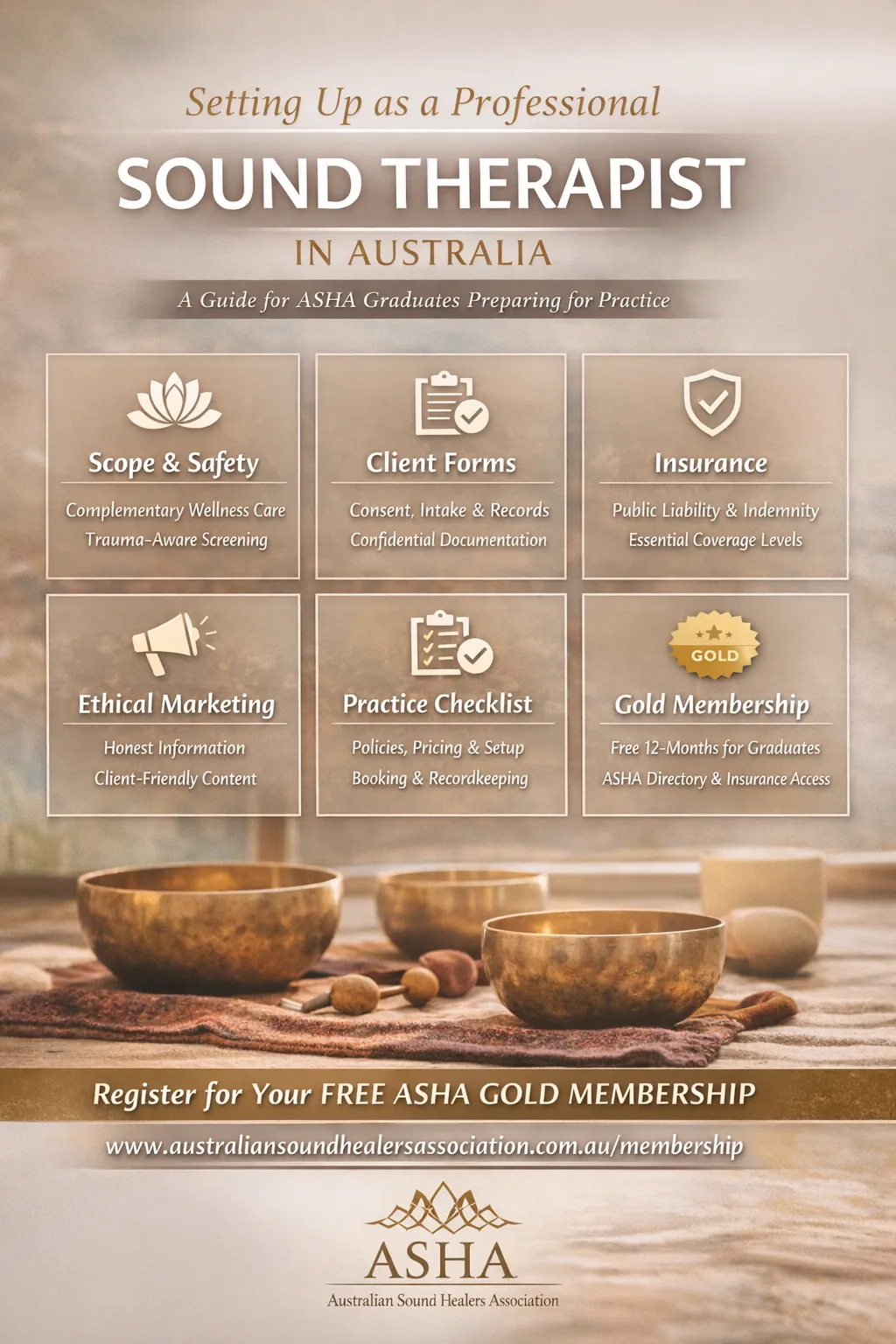
Setting Up as a Professional Sound Therapist in Australia
Setting Up as a Professional Sound Therapist in Australia
Insurance, Ethics, Visibility, and Professional Support by ASHA
As you near completion of your Sound Therapy Practitioner training, it's time to prepare for professional practice. This guide outlines what you'll need to launch ethically, legally, and confidently as a practitioner in Australia—including your Gold Membership, insurance, documentation, and scope of practice.
Understanding Your Scope of Practice
Sound therapy is a complementary, wellness-based modality. As a sound therapist:
You do not diagnose, treat, or cure medical conditions.
You offer sessions that support rest, emotional regulation, and nervous system balance.
You are trained to screen clients, refer out when appropriate, and honour your training limits.
Being clear about your scope protects you, your clients, and the profession as a whole.
Professional Documentation and Privacy
As part of your practitioner setup, you’ll need to establish:
Consent and intake forms with opt-out options and referral disclaimers
Secure client recordkeeping for session notes and screening outcomes
Clear safety guidelines in your session descriptions and follow-up material
ASHA provides editable templates as part of your training to support this setup.
Insurance Requirements in Australia
Before offering sessions to the public, even in a casual or community setting, you must hold:
Public Liability Insurance: Covers physical injury or property damage connected to your sessions.
Professional Indemnity Insurance: Covers claims related to your facilitation, such as inadequate advice or recordkeeping.
Coverage amounts usually start at $10 million (public) and $1–5 million (indemnity), depending on your venue and session type. These policies are required by most hosts, wellness spaces, and referral networks.
Trauma-Aware Safety Practices
As covered in your ASHA training, trauma-informed care is critical to safe practice. Key steps include:
Screening for contraindications (e.g., pacemakers, trauma, seizure disorders)
Allowing client control through opt-outs or distance adjustments
Keeping sessions grounded and paced with rest breaks and silence
Referring clients outside your scope when necessary.
Practitioner Setup Checklist
As you graduate and prepare for paid work, your checklist should include:
Scope and hygiene policies
Client forms and safety protocols
A cancellation and pricing policy
Equipment transport and venue setup planning
Booking method (link, form, or calendar)
Insurance documentation
Your ASHA Gold Membership and directory listing.
Ethical Visibility and Referrals
After graduation, your ability to attract and retain clients will rest on trust and professionalism. Ethical practice includes:
Describing sound therapy in accurate, trauma-aware language
Sharing grounded, scope-appropriate content
Using testimonials and referrals with permission only
Making bookings and aftercare resources clear and client-friendly.
Gold Membership: Your Gateway to Practice
To be listed in the ASHA directory and access insurance pathways, you must register for Gold Membership. As a training graduate, you are eligible for 12 months free to help you launch professionally with the right support.
Gold Membership includes:
Insurance eligibility through ASHA-recognised brokers
Use of your ASHA Gold digital badge
Directory listing to attract clients
Editable client forms and practitioner templates
Recognition as a trained, insured sound therapist
Register now at:
www.australiansoundhealersassociation.com.au/membership
Your Path Forward
Professional practice begins the moment you take ownership of your setup. By aligning with ethical standards, completing your documentation, and securing the right support through ASHA, you are stepping into your role as a sound therapist with integrity and clarity.
The world needs well-trained, safe, and grounded practitioners. We're here to support your next steps.